Start with the piece in every position
Convertible furniture earns its place by doing more than one job, but each job has a different footprint. A sofa bed may fit neatly against a wall as a sofa yet block a walkway when extended. A drop-leaf table needs room for its raised leaves and for chairs to pull out. Before shopping, write down what you expect the piece to do and where it will stand in each position.
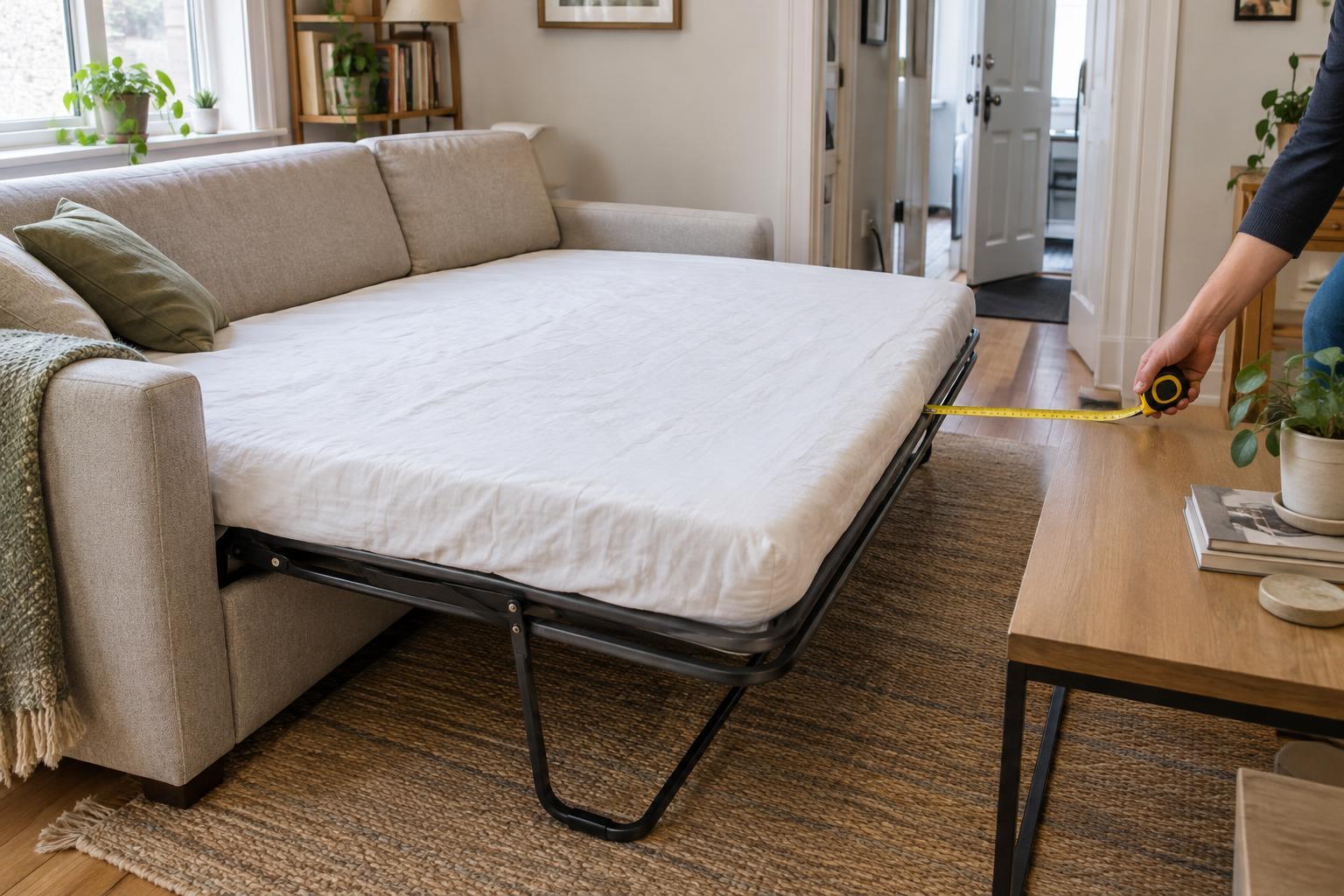
For each candidate, look for overall width, depth, and height when closed and fully open. Check whether those figures include handles, arms, a headboard, or projecting legs. Product diagrams can be more useful than a single list of dimensions. If the opening measurements are missing, ask for them rather than estimating from a photograph. Note which way the piece opens, too: a right-facing configuration may work where a left-facing one does not.
Measure the route into the room
Start at the entrance the furniture will actually use and trace the entire delivery route. Measure the clear width and height of door openings, including any narrow points caused by handles or trim. Check hallways, stairways, landings, and tight turns, not just the door to the final room. At a turn, a long box may need more maneuvering room than the straight hallway width suggests.
Compare those measurements with the packaged dimensions, which may differ from the assembled piece. Find out whether legs, arms, or other parts arrive separately and whether the item requires assembly in the room. Do not assume a piece can be tilted through an opening simply because one of its dimensions is smaller than the doorway: the other dimensions and the space available to rotate it matter. If access looks close, confirm the delivery and assembly details with the seller before ordering.
Map the everyday floor space
Measure the usable area of the room, including the positions of doors, radiators, outlets, and furniture you plan to keep. Then mark the closed footprint of the new piece on the floor with painter’s tape or paper. Walk around it as you normally would. Can you reach a closet, open a drawer, and move between the main areas of the room without sidestepping?
A quick sketch helps when a room serves several purposes. For example, a folding desk might be compact after work, but its chair still needs somewhere to go. A storage ottoman may fit beside a sofa, yet its lid might hit a nearby table. Measure from fixed obstacles rather than from an empty-looking patch of floor, and allow some tolerance instead of planning a layout that works only to the last centimeter or inch.
Test the full opening clearance
Next, mark the furniture’s open footprint using its stated dimensions. Include the path it takes while changing shape, not just its final position. A pull-out sleeper needs clear floor in front of the sofa; a lift-top coffee table needs space above and around the rising surface; a folding table needs room to swing its leaves. Check doors, drawers, curtains, and low light fixtures for possible collisions.
Think about the people using the piece as well. A bed that technically fits may leave no comfortable route to the bathroom at night. A table may open fully but offer no practical space to sit down or stand up. Try walking the routes and miming the opening motion inside your taped outline. This simple test can reveal conflicts that a floor plan misses, especially in rooms where furniture must be moved before the conversion can happen.
Make a final check before committing
Keep a short list of three sets of figures: packaged dimensions for delivery, closed dimensions for daily use, and open dimensions for the furniture’s second function. Recheck your room measurements, then compare each set with the relevant space. If a product has drawers, reclining parts, or removable cushions, check how those features affect clearance and where any loose components will be stored.
Finally, consider how often you will convert the piece. Moving a coffee table once in a while may be reasonable; moving it every evening to open a bed may become a nuisance. When two options fit, the better choice is often the one that leaves a simple, repeatable routine. Measuring first does not guarantee a perfect purchase, but it gives you a much better way to judge whether a flexible piece will truly make the room easier to use.