Start with what the drawer needs to hold
Before shopping for inserts, empty the drawer and group its contents by how you use them. Put daily essentials together, set occasional items aside and remove anything that belongs elsewhere. This shows you whether you need several small compartments, a few long ones or simply a way to stop one category from sliding into another.
Notice the awkward items first. A long utensil, a bulky charger or an unusually wide office supply may determine the layout more than a handful of small objects. Measure those pieces or place them on a sheet of paper in a rough arrangement. Leave a little room around items you pick up often; a compartment that holds something tightly can make it frustrating to retrieve.
Measure the usable space, not just the drawer front
Measure the inside width from side to side, the inside depth from front to back and the height from the drawer bottom to its lowest obstruction. Measure in more than one spot if the sides are uneven or the drawer has rounded corners. A drawer front may look generous while the box behind it is much smaller.
Check what happens as the drawer opens and closes. Rails, screw heads, a recessed handle or the underside of the cabinet can interfere with a tall insert. If the drawer opens only partway, a deep compartment at the back may be difficult to use. Record the dimensions and note any obstructions before comparing products. For rigid trays, allow some clearance rather than assuming an exact-width insert will drop neatly into place.
Match the insert to the contents
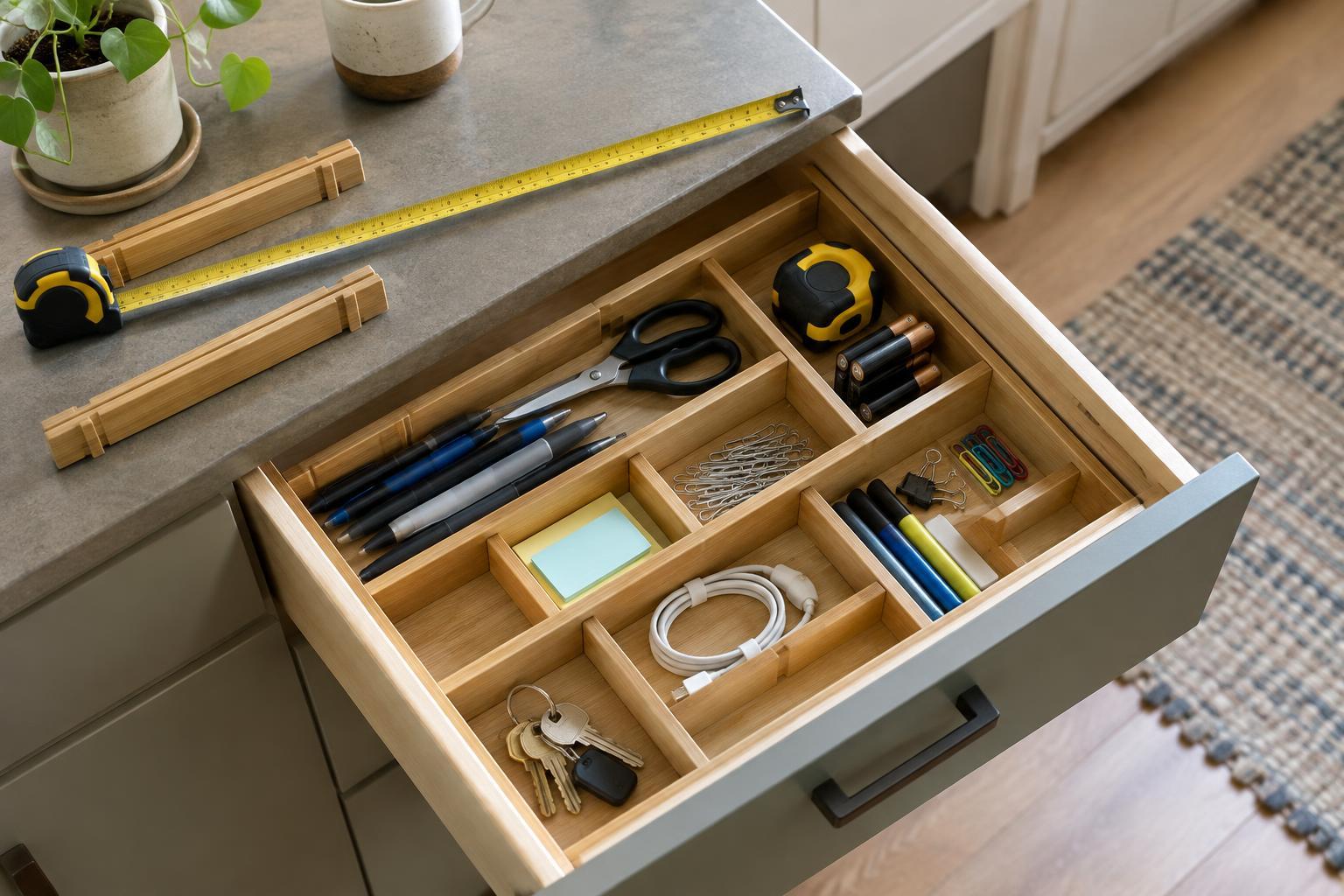
A single tray with fixed compartments can work well when the contents rarely change and the compartment sizes suit them. Look at the dimensions of the individual spaces, not only the tray’s overall size. Several tiny sections will not help if most of your belongings are wide or long.
Adjustable dividers offer more flexibility for drawers that hold a changing mix of items. Check how they stay in position: some press against the drawer sides, while others connect to a base or to neighboring pieces. Expandable trays can cover more width, but extending them may create a narrow extra section that is useful only for certain items. Separate small bins let you rearrange categories, although they may move around if there is too much empty space.
The best layout does not have to fill every corner. Open space can make room for an oversized item or give you somewhere to set an object down briefly. If a proposed arrangement creates a perfect grid but makes familiar items harder to reach, simplify it.
Consider materials, cleaning and cost
Choose a material that suits the drawer’s job. Smooth plastic inserts are usually straightforward to wipe down, which can be helpful for bathroom supplies or kitchen tools. Wood or bamboo can suit a desk or bedside drawer, but check how the surface should be cleaned and whether it may be exposed to moisture. Fabric-covered boxes may feel gentler around delicate accessories, though they can be less convenient when spills or crumbs are likely.
You do not need to buy a matching set for every drawer. Start with the drawer that causes the most daily searching, and compare the cost of a full insert with a few individual bins or adjustable strips. Reusing clean, sturdy small boxes can help you test compartment sizes before spending money. Avoid containers with sharp edges or sides that catch as the drawer moves.
Test the layout in everyday use
Before committing to an arrangement, make a temporary layout with folded paper, cardboard or the boxes you already have. Place the actual belongings inside, close the drawer and open it as you normally would. Check that nothing tips over, catches on the cabinet or disappears behind a taller item. If other people use the drawer, make sure the groupings are easy for them to understand too.
After a few days, adjust any compartment that keeps collecting unrelated things. That may mean an item needs a new home, a section is too small or the drawer has more divisions than it needs. A useful insert should make putting things away as easy as finding them; if maintaining the layout feels like extra work, choose a simpler one.