First, understand what the names mean
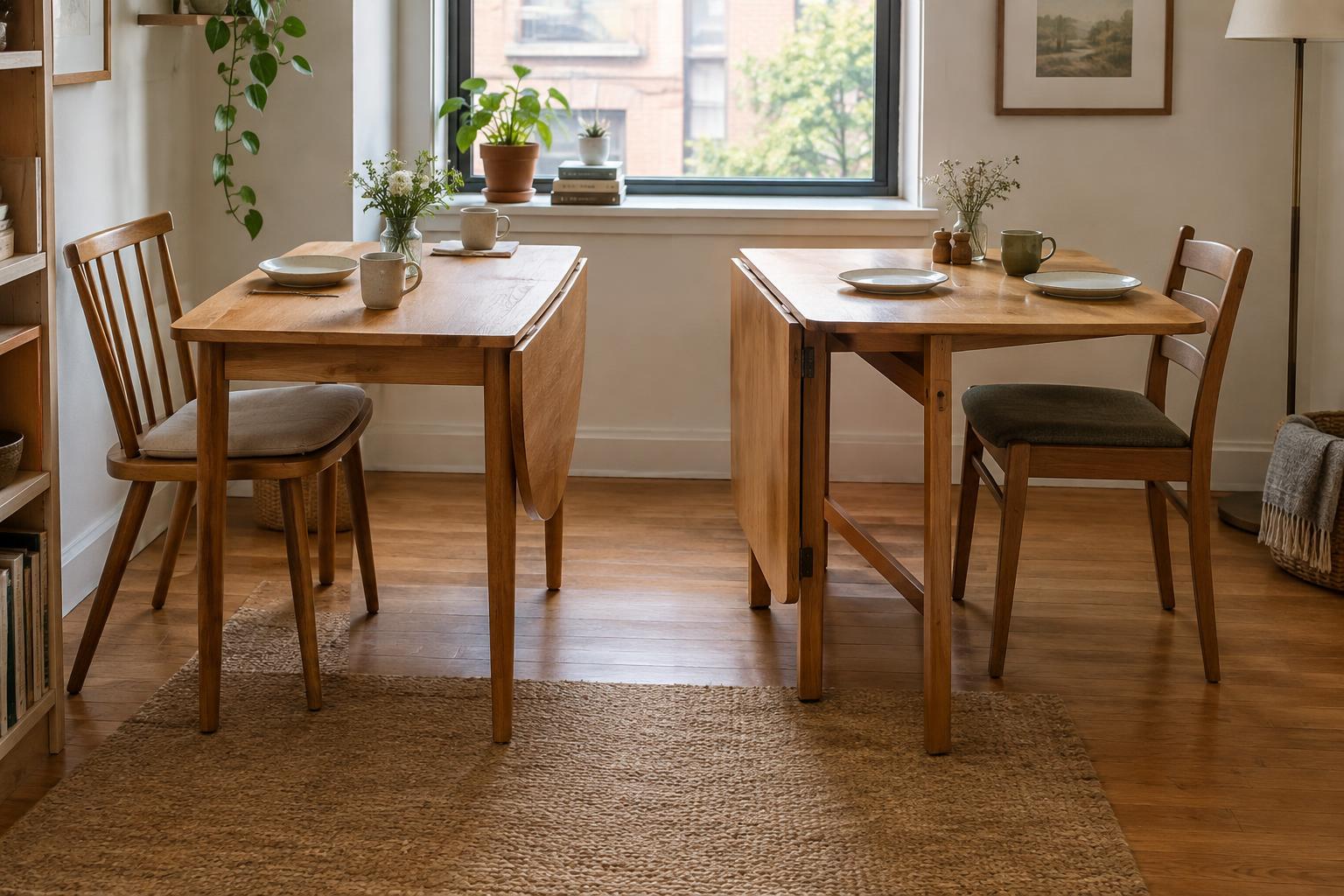
A drop-leaf table has one or two hinged sections that hang down when they are not needed. “Drop-leaf” describes the tabletop, not a particular kind of base. A gateleg table is a type of drop-leaf table whose leaves are supported by legs that swing out like gates. Other drop-leaf tables may use sliding supports, hinged brackets or a fixed base instead. When shopping, compare the support mechanism rather than relying on the product name alone.
For everyday meals, the useful question is not just how small the table gets. It is whether the table feels convenient in the position you will use most often. A compact table that takes effort to open, blocks a walkway when in use or puts a leg exactly where someone wants to sit may be less practical than a slightly larger one.
Compare the space each table actually uses
A gateleg table can fold into a narrow footprint, which suits a room where the dining area must disappear between meals. You might keep it against a wall during the workday, then pull it out and open both leaves for dinner. Remember to allow space for the swing of the legs as well as for chairs. A gateleg can be narrow when closed but still require a generous clear patch of floor when fully opened.
A drop-leaf table with a fixed base may not fold quite as slim, depending on its design, but it can be simpler to place. Some work well with one leaf raised and the other against a wall, creating a dependable spot for one or two people. Do not assume every table is stable or comfortable in that arrangement: check how the raised leaf is supported and whether the base sits level when only one side is open.
Measure three setups before buying: closed, one leaf open and fully open. Mark each outline on the floor with removable tape, then pull out the chairs you intend to use. Leave enough room to get in and out and to pass behind a seated person where needed. This quick test tells you more than the tabletop dimensions alone.
Think about knees, chairs and daily setup
Gatelegs provide direct support beneath the leaves, but their position can limit where people sit. On some models, a swinging leg falls close to the center of a chair space. This may be easy to work around for an occasional guest and irritating at every breakfast. Look at the table with chairs in place, not just standing empty in a showroom or product photo.
On a non-gateleg drop-leaf table, support brackets or slides may leave more open floor beneath a leaf. That can improve legroom, though the result depends on the particular base and mechanism. Check for low crossbars, wide feet and anything that might catch a chair. If you are buying secondhand, open and close each leaf yourself; it should move smoothly and stay securely supported without needing to be held in place.
Also consider how many steps stand between the closed table and a meal. If you expect to open it twice a day, a mechanism you can operate easily matters. A table that usually stays open on one side may be a better everyday choice than one that achieves an impressively small folded size but makes each meal a furniture-moving exercise.
Choose for your routine, not the biggest possible dinner
For a household that normally seats one or two, a drop-leaf table that feels sturdy with one leaf up is often a sensible starting point. It can offer a regular eating surface without claiming the whole room. If the same space must regularly switch from desk or play area to dining area, a slim-folding gateleg may be worth the extra setup, especially if its legs do not interfere with your usual chairs.
If you occasionally seat more people, test the fully open table against the size of plates, serving dishes and chairs you actually use. The number of chairs that fit around an edge is not necessarily the number of people who can eat comfortably there. It may be more useful to keep a comfortable everyday table and plan a simpler serving arrangement for guests than to optimize every day around an occasional large meal.
Budget for the whole setup, not just the table. Existing chairs may be too wide to tuck under it, while folding or stackable chairs need somewhere to go when stored. A well-functioning secondhand table can be good value if its hinges, supports and top are sound. Check those parts carefully rather than judging only the finish, since cosmetic wear is often easier to live with than a wobbly leaf.
Make the final check in person if you can
Sit at each side you expect to use, open and close the leaves, and give the tabletop a gentle check for wobble. Confirm that the table remains practical in its partly open position if that is your everyday plan. For a gateleg, make sure the legs swing freely in the space you have marked out; for another drop-leaf design, confirm that its supports are easy to engage and do not obstruct knees.
Neither style is automatically better for small rooms. A gateleg often wins when the closed footprint matters most. A drop-leaf table with a different support system may win when one-leaf dining, quick setup or unobstructed chair space matters more. The best everyday table is the one whose most-used position fits both your floor plan and the way you actually eat.